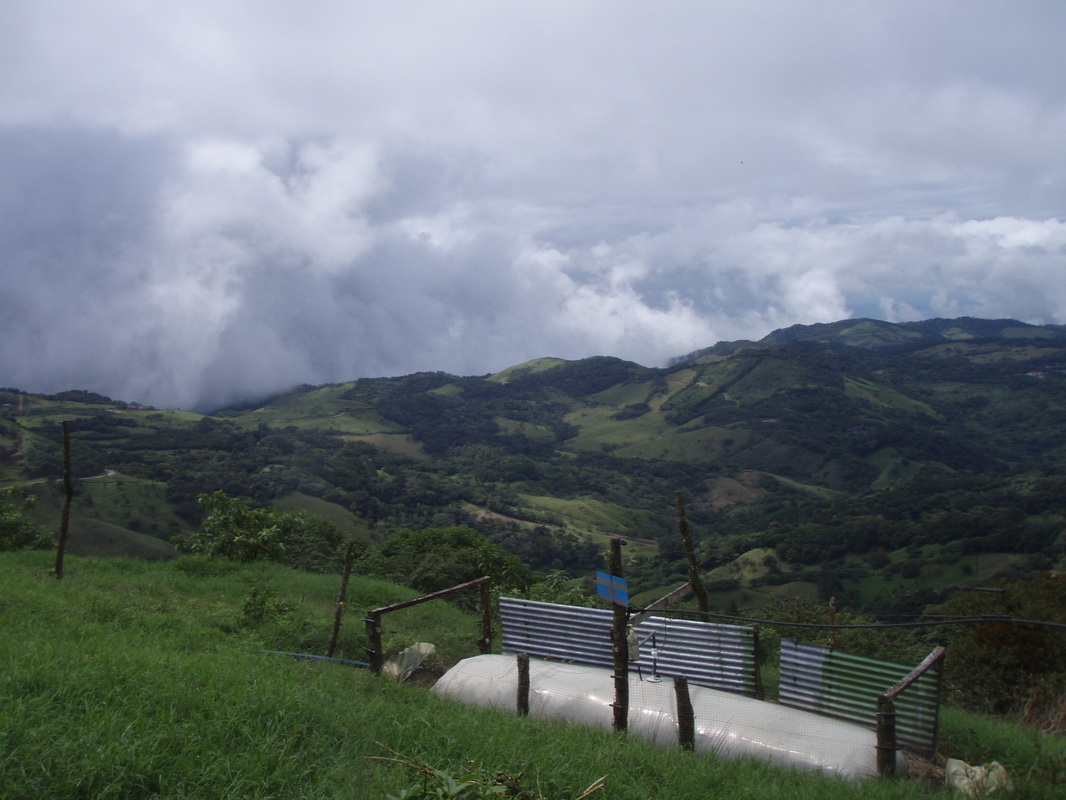
Phillips sensory ecology lab
The Phillips Lab builds on previous research to expand from behavioral responses to anthropogenic development and aims to deeper understand trends in populations and communities, using model systems in California, New Mexico, and Texas, as well as large community driven data to understand patterns of global change.
We examine the fitness consequences of sensory pollution and aim to test hypothesized direct and indirect, predator mediated consequences of exposure. Parsing out the consequences of sensory pollution caused by anthropogenic activities lays the groundwork for conserving wild places, species, and reconciling spaces where nature and mankind interact.
We examine the fitness consequences of sensory pollution and aim to test hypothesized direct and indirect, predator mediated consequences of exposure. Parsing out the consequences of sensory pollution caused by anthropogenic activities lays the groundwork for conserving wild places, species, and reconciling spaces where nature and mankind interact.
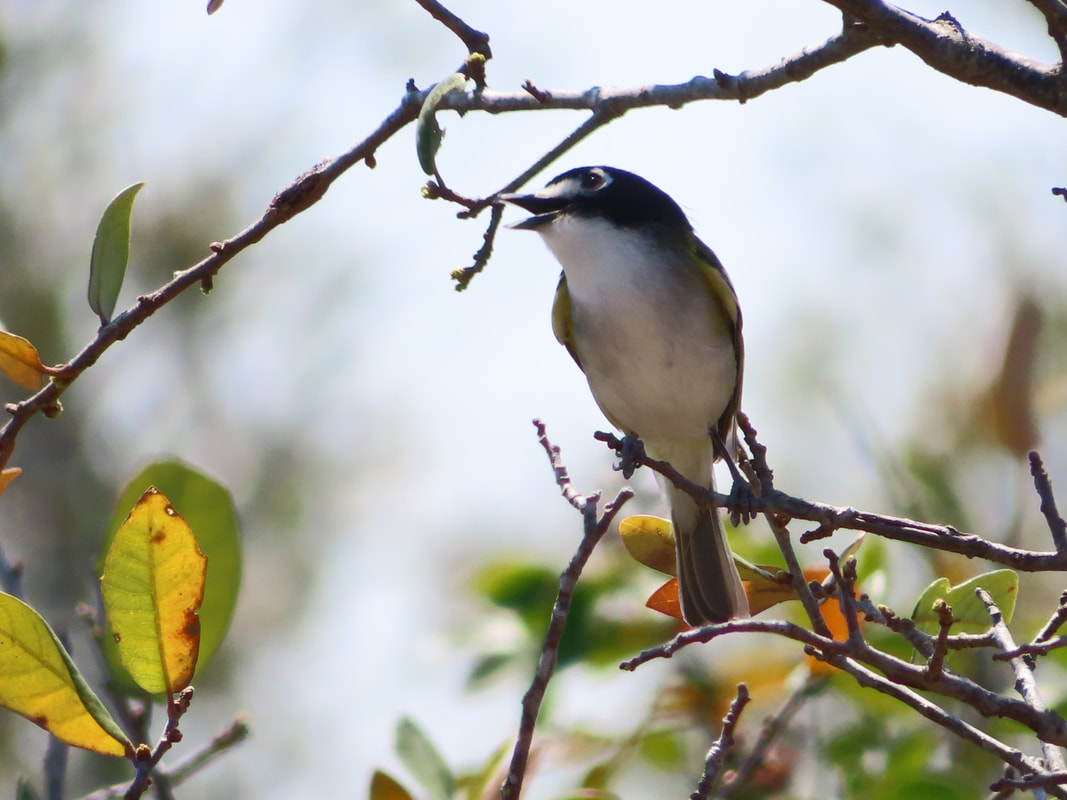
Black-capped Vireos at Government canyon State natural Area
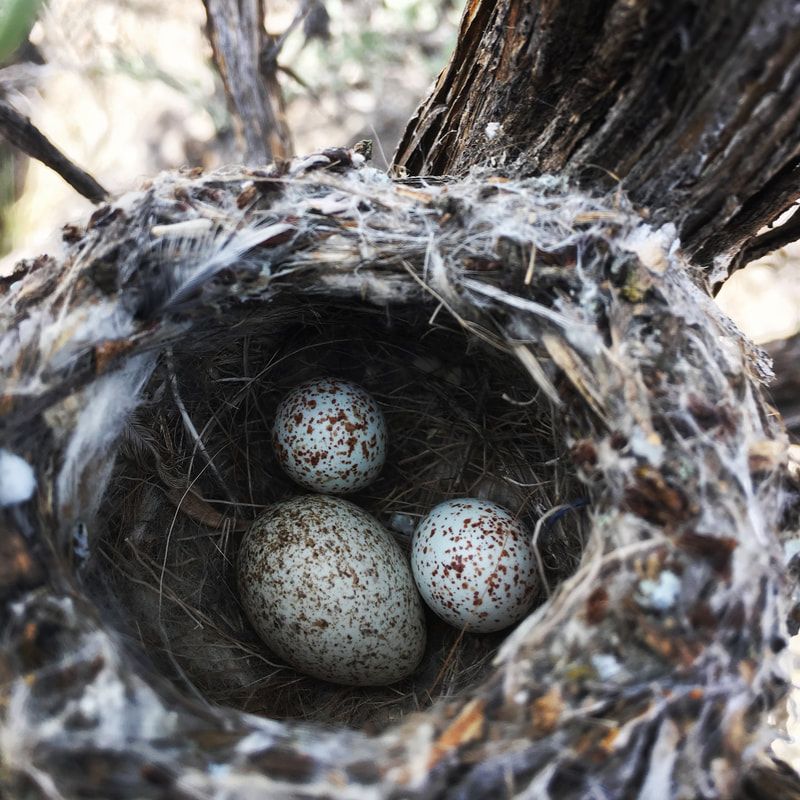
Black-capped vireos (Vireo atricapilla) are a threatened but recently delisted songbird that have shown up at San Antonio's largest natural area, Government Canyon. Along with state biologists and collaborator Brittany Slabach (Trinity University), we are monitoring nesting attempts and success in relation to habitat quality. This data will be used for adaptive management to encourage recovery of this species.
Long Term SEnsory Pollution Experiment
Over evolutionary timescales the sensory environment has provided reliable channels through which animals have received and dispatched signals to interact with other organisms and entrain their physiology. Recently, the rise in multimodal anthropogenic pollution—noise and nightlight—present conditions that are unprecedented in the fossil record and could fundamentally disrupt the ways in which organisms interact and respond to environmental cues. Limited research has focused on the singular effects of noise or light on animal communication and reproduction. However, evidence for an influence of these stimuli on fitness is equivocal. Moreover, because these stimuli typically co-occur in today’s human-dominated world, understanding their combined influence is an urgent conservation priority. We test the effects of noise and light pollution on adult movement, breeding success, and fledgling survival of a community of birds in New Mexico. To do this, we have implemented a large-scale manipulative field experiment with four treatments (Noise, Light, Light+Noise, & Control). By measuring settlement patterns, reproductive success, and activity states, we tested mechanistic pathways that link exposure to sensory stimuli to changes in fitness.
PhD Research
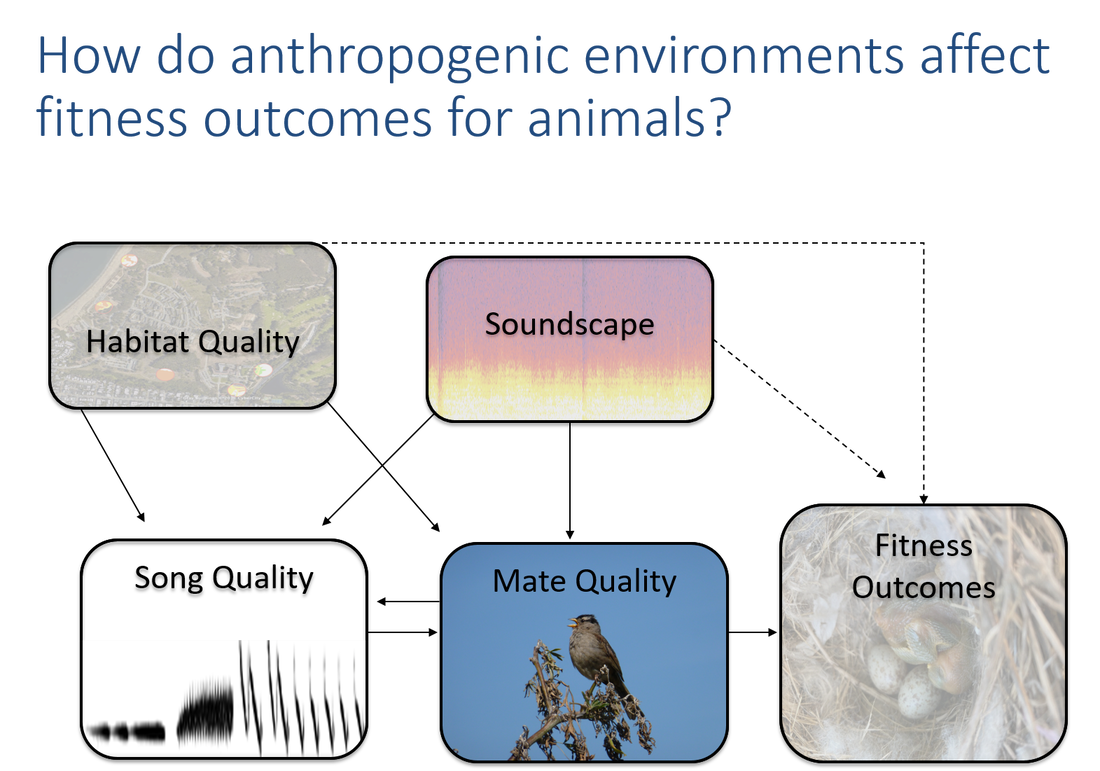
My dissertation research focuses on whether and how vocal performance is used by Nuttall's white-crowned sparrows (Zonotrichia leucophrys nuttalli) for male-male competition and female choice across soundscapes. One evolutionarily recent pressure on song evolution is the occurrence of cities and the associated increase in ambient noise, and many species have been observed to change the pitch (frequency) or duration of their song in loud areas. White-crowned sparrows sing a variable song containing a trill, and are well studied for song evolution and acoustic adaptation. The range of frequencies (bandwidth) and the rate of notes (trill rate) in trills are physically constrained by beak movements actively tracking the fundamental frequency. This tradeoff can be measured by vocal deviation and is thought to be an honest trait, but selection on song from increased ambient noise may affect whether performance is a salient signal for receivers.
I've established color-banded populations in San Francisco and Point Reyes National Seashore in California to address this overarching question, as SF is an urban environment filled with anthropogenic noise, and Point Reyes is a relatively quiet, rural location. My dissertation investigates:
1) Do male white-crowned sparrows use vocal performance to assess competitors across landscapes?
2) Is vocal performance itself the salient signal, or does bandwidth or trill rate matter more to receivers?
3) Does territory noise level (LAeq) affect male response to vocal performance and it's components?
I've established color-banded populations in San Francisco and Point Reyes National Seashore in California to address this overarching question, as SF is an urban environment filled with anthropogenic noise, and Point Reyes is a relatively quiet, rural location. My dissertation investigates:
1) Do male white-crowned sparrows use vocal performance to assess competitors across landscapes?
2) Is vocal performance itself the salient signal, or does bandwidth or trill rate matter more to receivers?
3) Does territory noise level (LAeq) affect male response to vocal performance and it's components?
Masters Thesis
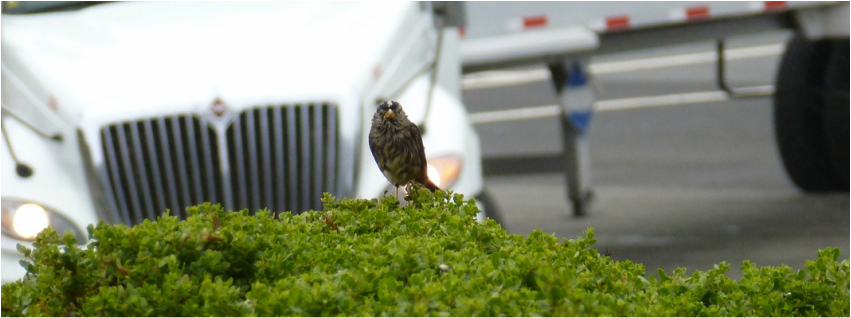
How is winter song affected by anthropogenic noise?
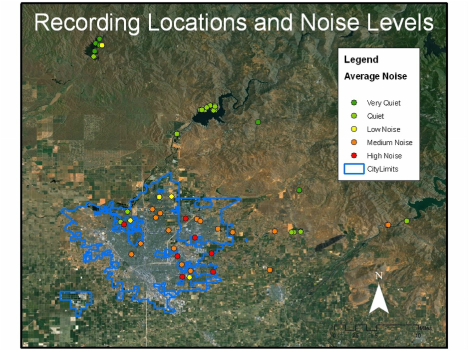
My master's thesis investigated how anthropogenic noise affected winter song in Gambel's white-crowned sparrow in the Fresno-Clovis Metropolitan Area.
UNDERGRADUATE RESEARCH
How do vocalizations vary across landscapes?
How do vocalizations vary across landscapes?
My undergraduate research project investigated geographical differences in Great-tailed grackle vocalizations across landscapes in Costa Rica.